Practical Training: Farm Truck Driving Techniques and Maneuvers to Get You Hired
It can take years before you finally get the call for an H-2A interview and receive a job offer. Competition for H-2A jobs is tough, and with more and more American farm employers bringing the same workers back year after year, candidates need distinctive skills to secure opportunities.
Truth is, American farm employers want to see that you have the skills they’re looking for before scheduling an interview or making a job offer. USA Truck Labor’s training prepares you with skills for driving American semi-trucks and teaches you techniques designed to help you stand out and get hired. Today’s blog dives into our training program to discuss the techniques and maneuvers we teach to help you land that job and start your new career in American agriculture.
Safety Procedures and Techniques
One of the training program’s main focuses is on safety practices and safe operation of the truck. American farm employers value safety over many other skills because:
Accidents cost valuable time and money
Workers' Compensation insurance claims can be costly
Accidents can trigger government H-2A field audits
Employers care about worker safety and well-being
Safety includes things like defensive driving, pre- and post-trip inspections, coupling and decoupling trailers, docking, parking, and more. The employers have a lot at stake with each growing season. A vehicle accident means that vehicle is likely out of commission for an extended period of time. Crops suffer, operators suffer, and your farmer’s bottom line takes a hit. Safety is a top priority for farm employers, so being a proven “safe” driver or equipment operator can and will get you hired.
Read more about the importance of defensive driving on farms
Parking, backing, and docking maneuvers
The ability to navigate the truck in tight places is a skill that not all drivers and operators possess, but American ag employers want to know you can perform these precision techniques:
Parking: The ability to park the truck in tight, often cramped spaces surrounded by buildings, livestock, and other farm structures is essential.
Backing: Driving in reverse is hard, but especially tough in a truck where you must rely on your mirrors to guide you backwards. Trucks have many blind spots, so you’ll need a keen awareness of your surroundings before backing.
Docking: Maneuvering the truck to a dock so you can unload your trailer is a precision technique. Accurately docking a truck on the first try takes a lot of practice. Factor in that you must dock the truck in reverse, using only your mirrors, and it’s easy to see why this is a valuable skill employers are looking for.
Shifting
You’ll need to know various shifting techniques to be able to drive a semi-truck on a farm in America. There are two types of shifting maneuvers when driving a semi-truck:
Double clutch: This is the process of depressing the clutch to shift gears into neutral, letting the clutch out for a brief second, using the accelerator pedal to match engine RPMs (rotations per minute), and pressing the clutch again to shift the truck into the desired gear, up or down. Double clutching is essential because on the downshift it keeps the truck from bucking, which can cause you to lose control and jackknife the trailer, and on the upshift it helps the truck smoothly transition to the higher gear without losing power in the engine and drivetrain.
Floating: This refers to the process of depressing the clutch and shifting the truck into a higher or lower gear without ever letting go of the clutch, so one smooth shifting motion from gear to gear. There are times when you need to “float” the gears to keep the truck moving smoothly.
American farm employers will expect you to understand how and when to execute both shifting styles, while maintaining best safety practices.
Learn more about what American employers expect in your first 30 days
Coupling and decoupling trailers
One of the top skills you can possess as an H-2A driver and operator is efficiently coupling and decoupling trailers. Connecting and disconnecting trailers is where many of your driving skills, such as backing and shifting, come together. Here are the steps you’ll need to perform:
Inspect the fifth wheel: Check to be sure the fifth wheel connection is free from debris and is in good repair.
Align the truck with the trailer: Carefully back the truck into the trailer until the rear axle is aligned under the trailer and get out to verify your alignment. If alignment is good, keep backing until the kingpin connects with the trailer.
Tug test: Gently test the connection with the kingpin and the trailer by putting the truck in a forward gear and engaging to test if the connection is secure.
Connect lines: Connect the emergency lines and air lines from the truck to the trailer.
Raise landing gear: Raise the landing gear of the trailer so you’re ready to travel, but be sure to replace the landing gear handle in the holding bracket.
For decoupling the trailer, you will:
Locate the correct landing spot
Re-engage the landing gear
Disconnect the lines
Release the kingpin and pull away from the dropped trailer
You’ll need to be able to back the truck to the trailer with precision and efficiency. Your employer wants to know you can quickly connect a trailer, follow the necessary safety procedure, and be on your way without delays or safety issues.
Navigating various terrains
One of the most challenging aspects of farm truck driving is navigating different terrains. USA Truck Labor’s training program is designed to simulate real farm driving, so candidates are put to the test by being asked to operate the truck over various terrains such as:
Dirt
Sand
Gravel
Grass
Pavement
Training also involves “around town” driving in mixed traffic. Exposure to various terrains prepares you for driving in a real farm environment where you’ll drive over different surfaces daily. From dirt roads to grass fields to paved roads, you can expect to drive in a variety of environments during an H-2A season.
Mastering the left-hand drive truck
In America, vehicles are operated from the left-hand side of the cab. The left-hand drive feature is one of the biggest differences between driving in America and driving here in South Africa. Here are some of the main differences:
Shifting with your right hand
Clutching with your left foot
Steering with your left hand while shifting
Switching from a right-hand drive vehicle to left-hand drive is a challenge in itself. Add in that you’re driving a large semi-truck, and this aspect of training can be extremely challenging for our candidates. Master the left-hand drive feature and get comfortable, and you’ll be on the fast track to successfully driving a truck in America.
Basic mechanical and truck maintenance
Our truck training program wouldn’t be complete without an overview of basic mechanical and maintenance procedures. Here are a few of the areas covered in the maintenance and mechanical sections of training:
Tires
Steering and brakes
Lights and reflectors
Fluid levels
If you have pre-existing mechanical or truck maintenance skills, those will go even further on an American farm. It’s very common for seasonal H-2A employers to need mechanics for the winter season, or off-season depending on where you’re located, when the equipment isn’t in use. Off-seasons are the perfect time to work on equipment, conduct routine maintenance, and make critical repairs to machines and equipment in preparation for the following growing season.
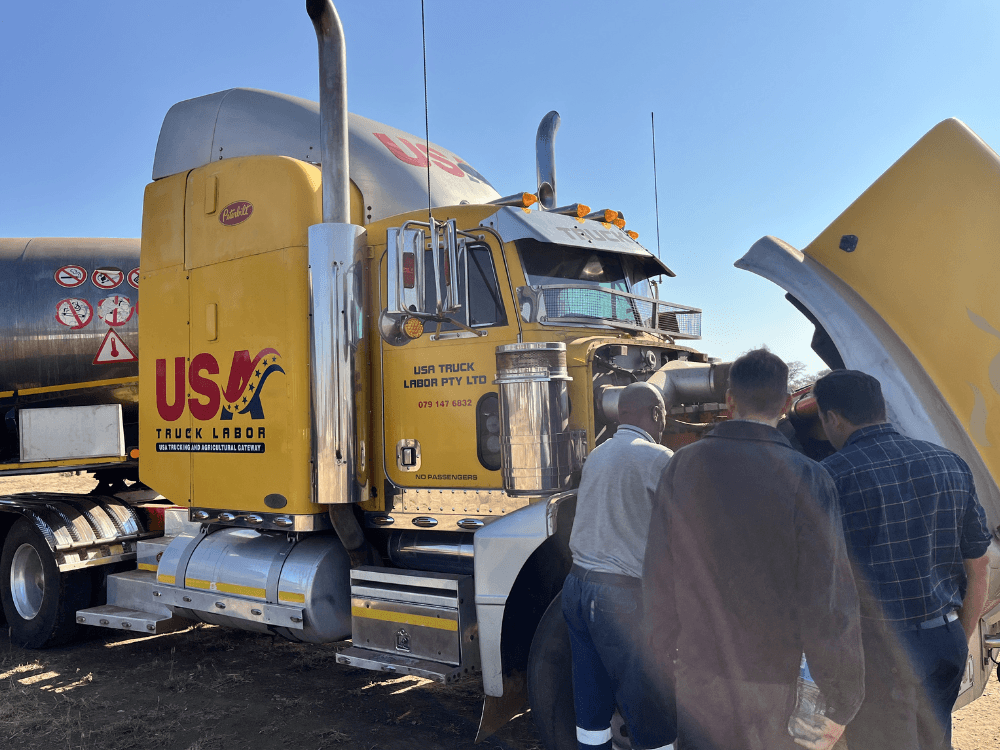
Learn the skills employers are looking for with USA Truck Labor’s training program
Our team has been to America, stepped foot on American farms, and talked directly with American ag employers to uncover exactly what skills they’re looking for in their seasonal farm employees—and we designed our program around these experiences. Our exclusive partnership with USA Farm Labor, one of the biggest H-2A agencies in America, has helped position our training program to meet the direct needs of ag employers. As a result, we’re constantly evolving our program to meet those needs and help you land the job of your dreams in the U.S. ag industry.
Book a call online now with our resident director, Jandre Eksteen, and secure your training spot. Space is limited, so you must act fast.